Stock Code
301528

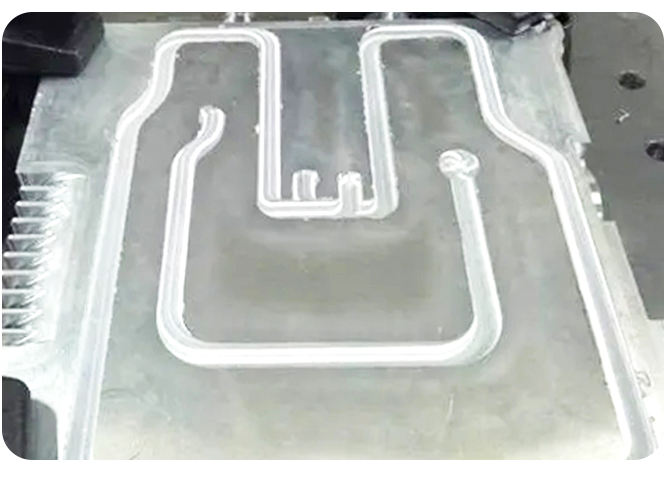
FSW of New Energy Vehicle Cooling & Electrical Control Box
Friction Stir Welding (FSW) is an innovative solid-state welding process. A specially designed stirring pin is inserted into the welding zone of the workpiece. The high-speed rotating stirring tool generates friction and stirring action between the tool and the workpiece. The frictional heat softens the base metal into a thermoplastic state. Under the pressure of the stirring tool, the plasticized metal flows from the front to the rear of the tool, realizing solid-state joining and integrating the workpieces into a unified whole.

Friction Stir Welding Process
Technical Characteristics of FSW
Compared with fusion welding, friction stir welding features low heat input. No metal melting occurs at the joint, making it a solid-state welding process. It preserves the metallurgical properties of the base material for alloys and enables the welding of metal matrix composites, rapidly solidified materials, and other materials that tend to produce adverse reactions during fusion welding.
Main Advantages:
1.The heat-affected zone of the welded joint has negligible microstructure variation with low residual stress, resulting in minimal deformation of welded workpieces.
2.It can complete long welds, large cross-sections and multi-position welding in a single pass with high joint performance.
3.The process is easy to realize mechanization and automation, with simple equipment, low energy consumption, high efficiency and low requirements for working environments.
4.No welding filler wire is required. Pre-welding oxide film removal and shielding gas are unnecessary for aluminum alloy welding, effectively reducing overall costs.
5.It is suitable for welding materials sensitive to hot cracking and dissimilar materials.
6.The welding process is safe and environmentally friendly, with no pollution, welding fume or radiation hazards.
Disadvantages:
The welded workpiece must be rigidly fixed with a backing plate on the reverse side. When the stirring pin is withdrawn from the workpiece upon welding completion, a keyhole is formed at the weld end, and subsequent weld repair is difficult. Tool design, process parameters and mechanical property data are only available for a limited range of alloys.
In certain application scenarios, such as special fields with strict requirements on corrosion resistance, residual stress and deformation, the overall performance needs to be further improved for practical service.
The welding speed is relatively low for single-pass joining of plates. In addition, the wear and consumption of stirring tools are relatively severe.
Typical Applications of FSW Technology
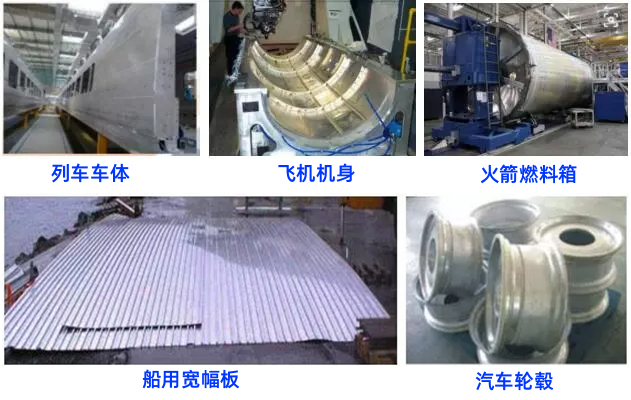
(1) Power industry: heat sink fins, pipelines, heat exchangers, etc.
(2) Automotive industry: wheel hubs, truck bodies, caravan and three-dimensional frames, as well as cooling and electric control boxes for new energy vehicles.
(3) Aerospace industry: aircraft fuselages, rocket fuel tanks, aerospace vehicle shells, radar panels.
(4) Shipbuilding industry: face plates and large-scale plate components for containers.
(5) Railway industry: large plate parts for rail transit (EMU carriages, bottom plates, and freight car side panels).
Common Defects in FSW
Common defects of friction stir welding include surface defects (such as surface grooves, flash, surface peeling and root weld beads) and internal defects (such as porosity, incomplete penetration, kissing bond defects, etc.).
In addition, due to the process characteristics of friction stir welding, defects with random orientations may also form inside the weld. Therefore, to control the welding quality and prevent workpieces with potential defects from entering subsequent production processes, timely inspection after friction stir welding is highly essential.
Automatic Inspection System for FSW
The Doppler automatic phased array inspection system for friction stir welding is an integrated ultrasonic phased array testing solution based on phased array technology. It combines multi-axis motion modules, inspection water tanks, and fully automatic inspection and analysis software.
This system is mainly applied to identify and measure common defects in friction stir welds. In accordance with user-defined acceptance criteria, it realizes automatic evaluation of inspection data and outputs test results in real time.